
Best EV cars in 2026: top picks for every type of driver
The best EV cars right now are the Hyundai IONIQ 5 for overall balance, Chevrolet Equinox EV for budget value, Kia EV9 for families, BMW i5 for luxury, Lucid Air for long-range driving, and Tesla Model Y for SUV practicality. These picks stand out because they solve different buyer problems well instead of chasing one headline stat.
Shopping for the Best EV cars is finally more about choosing the right fit than asking whether EVs are ready. In 2026, there are strong options for commuters, road-trippers, growing families and buyers moving up into luxury. The trick is comparing price, EV range, charging speed, interior space and warranty support in a way that actually helps you decide.
Editor’s note: To keep this electric car comparison consistent, the quick table below uses current U.S. official figures where practical. If you are in the UK or Europe, trim names, taxes, incentives and advertised range figures may differ.
Table of contents
- How we selected the best EV cars
- Quick comparison table
- Best EV cars overall
- Best budget EV
- Best family EV
- Best luxury EV
- Best long-range EV
- Best EV SUV
- EV buying guide
- Common mistakes to avoid
- FAQ
- Conclusion
How we selected the best EV cars
I used six filters: usable official range, charging convenience, price-to-value ratio, family practicality, driving polish, and ownership confidence. That means a car did not win here just because it had the biggest battery or the cheapest sticker.
I also favored models with clear, current manufacturer data and broad buyer relevance. A brilliant niche performance EV is fun, but it does not help most readers looking for a sensible electric vehicle buying guide. The result is a shortlist that is easier to act on.
Quick comparison table
| Pick | Best for | Approx. U.S. price | Official range | Charging highlight |
|---|---|---|---|---|
| Hyundai IONIQ 5 | Best overall balance | Mid-$30k to around $50k | Up to 303 miles | 10–80% in about 18 minutes |
| Chevrolet Equinox EV | Budget value | $34,995–$44,095 | Up to 319 miles | Up to 84 miles in 10 minutes |
| Kia EV9 | Families | $54,900–$71,900 | 230–305 miles | 10–80% in as little as 24 minutes |
| BMW i5 | Luxury sedan buyers | $67,100–$84,100 | About 239–310 miles | Add 100 miles in about 11 minutes |
| Lucid Air | Maximum range | $70,900–$114,900 | Up to 512 miles | Up to 200 miles in 12 minutes |
| Tesla Model Y | EV SUV practicality | $41,630–$59,130 | 294–357 miles | Up to 182 miles in 15 minutes |
Table figures were checked against current official manufacturer sources, with Hyundai IONIQ 5 trim-range context cross-checked against MotorTrend because Hyundai’s live U.S. price structure is split across multiple pages.
Best EV cars overall
Hyundai IONIQ 5
Why it stands out: The Hyundai IONIQ 5 is still the most balanced answer for most buyers. It looks distinctive without trying too hard, packs a roomy cabin into a manageable footprint, and keeps one of the biggest real advantages in the segment: very fast charging for the money. Hyundai lists current U.S. range up to 303 miles, and the IONIQ 5’s 800V system can take the long-range version from 10% to 80% in about 18 minutes on a 350 kW charger. Hyundai also backs the battery with a 10-year/100,000-mile warranty in the U.S.
Best for: Buyers who want one EV that does nearly everything well, from daily commuting to weekend road trips.
Approx price range: from about $35,000, with the current market stretching to around the $50,000 mark for better-equipped trims. Driving range: up to 303 miles EPA. Charging highlights: 800V architecture, 350 kW fast-charging capability, and about 18 minutes from 10% to 80% on the right charger.
Review-based competitor content still consistently praises the IONIQ 5 for room, charge speed and all-around drivability, while pointing out that rear visibility and cargo space are not class leaders.
- Key pros: fast charging, spacious cabin, strong battery coverage, easy all-round ownership case
- Key cons: rear visibility is only average, lower trims give up a lot of range, cargo space is good rather than class-best
Best budget EV
Chevrolet Equinox EV
Why it stands out: Budget EV winners change by region, but in North America the Chevrolet Equinox EV is the strongest value play right now. Chevrolet starts it at $34,995, yet still quotes up to 319 miles of range for FWD models. That is exactly the kind of number that changes the ownership conversation because it removes the feeling that “affordable” must mean “compromised.”
Best for: Buyers who want the most range and day-to-day usability per dollar, especially first-time EV owners in the U.S. and Canada.
Approx price range: $34,995 to $44,095. Driving range: up to 319 miles for FWD and 307 for AWD. Charging highlights: 150 kW DC fast charging, up to 84 miles in 10 minutes for FWD, and roughly 10% to 80% in about 42 minutes.
That value story shows up in review-led competitor pages too: they highlight the range-for-price equation and quiet highway manners, while criticizing the lack of Apple CarPlay/Android Auto and the less engaging driving experience.
- Key pros: excellent value, big official range for the money, roomy cabin, easy everyday packaging
- Key cons: slower road-trip charging than 800V rivals, not especially sporty, software choices will not suit everyone
Regional note: In UK and Europe, the budget/value conversation shifts. Current UK-focused rankings repeatedly surface models such as the MG4 EV and Renault 5 E-Tech at the value end of the market, so global readers should always re-check what is actually sold in their region.
Best family EV

Kia EV9
Why it stands out: The Kia EV9 is the family EV that feels designed around actual family life rather than just headline specs. It seats up to seven adults, offers official range up to 305 miles, and can charge from 10% to 80% in as little as 24 minutes on a 350 kW DC fast charger. Kia also covers the EV battery and EV system with a 10-year/100,000-mile warranty in the U.S.
Best for: Bigger households, school-run duty, long family trips, and buyers moving out of a three-row gas SUV.
Approx price range: $54,900 to $71,900. Driving range: 230 to 305 miles depending on trim. Charging highlights: built-in NACS charge port, broad fast-charging access, and 10% to 80% in about 24 minutes.
Review-driven pages back up the family-first pitch: the EV9 gets credit for design, standard equipment, range and charging, while the main complaints are that lower trims are slower and the standard-battery version is the one to avoid for frequent long-distance use.
- Key pros: true three-row usability, fast charging, generous space, strong battery warranty, upscale feel
- Key cons: expensive once you move up the range, large footprint in tight cities, base battery is less convincing for road trips
Best luxury EV
BMW i5
Why it stands out: The BMW i5 is the best luxury EV here for buyers who still want their electric car to feel like a proper executive sedan. It is refined, quiet, handsome and familiar in a way many tech-first luxury EVs are not. BMW’s current i5 lineup starts at $67,100, stretches to $84,100 for the M60, and offers roughly 278 to 310 miles in the eDrive40 plus about 259 to 278 in the xDrive40. BMW also says a 350 kW DC fast charger can add 100 miles in about 11 minutes.
Best for: Luxury sedan buyers who care as much about quiet, quality and familiarity as they do about EV tech.
Approx price range: $67,100 to $84,100. Driving range: about 239 to 310 miles depending on version. Charging highlights: 0% to 100% in under 10 hours on 240V, about 100 miles added in 11 minutes on a high-power DC fast charger, plus growing Tesla Supercharger access through BMW’s network.
Competitor testing repeatedly highlights the i5’s interior quality, passenger space and balanced mix of efficiency and performance, but it also notes the touchscreen-heavy climate controls and the fact that it is more polished than playful.
- Key pros: premium cabin, strong brand support, comfortable long-distance manners, good charging ecosystem
- Key cons: premium pricing, touchscreen climate controls, M60 range and price are much harder to justify
Best long-range EV
Lucid Air Grand Touring
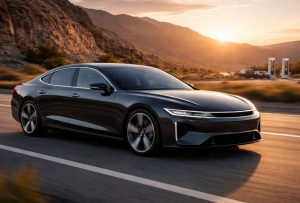
Why it stands out: If your single biggest priority is minimizing charging stops, the Lucid Air Grand Touring is the standout. Lucid says the Air Grand Touring can deliver up to 512 miles of EPA-estimated range, and its 900V+ architecture can add up to 200 miles in only 12 minutes on certain DC fast chargers. That changes road-trip planning in a real way.
Best for: High-mileage drivers, long-distance travelers, and buyers who want maximum range without moving to a huge SUV.
Approx price range: the current Air family starts at $70,900 for Pure, rises to $79,900 for Touring, and $114,900 for Grand Touring before Sapphire territory. Driving range: up to 512 miles in Grand Touring trim. Charging highlights: up to 200 miles in 12 minutes, plus an 8-year/100,000-mile high-voltage battery warranty retaining 70% capacity.
Review-led competitor content consistently praises the Lucid Air’s driving feel, cabin packaging and composure. The trade-off is clear too: the best long-range versions are expensive, and a sleek sedan body is not as inherently flexible as an SUV for families with bulky cargo.
- Key pros: class-leading range, outstanding fast-charging ability, premium cabin, excellent efficiency
- Key cons: long-range trim is costly, sedan practicality is limited versus SUVs, this is a more specialized buy than the IONIQ 5 or Model Y
Best EV SUV
Tesla Model Y
Why it stands out: The Tesla Model Y remains the EV SUV benchmark for buyers who care about cargo room, charging convenience and straightforward road-trip usability. Current U.S. pricing starts at $41,630, the range spans roughly 294 to 357 miles depending on trim, and Tesla quotes up to 182 miles added in 15 minutes on the best-performing version. Premium trims also offer up to seven seats and 76 cubic feet of cargo space.
Best for: Buyers who want a practical midsize EV SUV with strong software, high utility and easy fast-charging access.
Approx price range: $41,630 to $59,130. Driving range: 294 to 357 miles depending on trim. Charging highlights: 225 to 250 kW Supercharging, with 144 to 182 miles added in 15 minutes depending on version.
Competitor reviews now tend to praise the improved cabin, comfort and space, but they still flag the all-screen control philosophy as distracting for some drivers. That is the core Model Y trade-off in one sentence.
- Key pros: very usable cargo area, strong range, quick charging, widely understood ownership ecosystem
- Key cons: touchscreen-first cabin is not for everyone, trim differences matter more than the nameplate suggests, the more premium versions are not cheap
EV buying guide
Start with your charging routine, not your dream range
If you can charge at home or at work, you probably do not need the biggest battery on the market. Many buyers overspend on range they only use for a handful of trips each year. A well-priced EV with reliable fast charging is often the smarter purchase than a more expensive model with a massive battery.
Compare range figures on the same test standard
Do not compare an EPA figure with a WLTP figure and assume they are equivalent. For example, Hyundai USA currently quotes the IONIQ 5 at up to 303 miles, while Hyundai UK quotes up to 354 miles for its local version. Always compare like with like inside your own market.
Watch the trim strategy
The badge is only half the story. Some base trims are great value, while others cut too much battery, performance or equipment. The EV9 is a good example: its range varies from 230 to 305 miles depending on trim, which can completely change whether it works as a family road-trip car.
Check battery warranty and service backup
Battery coverage is one of the easiest quality signals to compare. In the U.S., Chevrolet, BMW and Lucid currently sit at 8 years/100,000 miles for the high-voltage battery, while Hyundai and Kia offer 10 years/100,000 miles on their battery-related EV coverage. Tesla’s battery warranty varies by trim.
Test the software before you buy
Infotainment matters more in an EV because so much of the charging, pre-conditioning and route planning lives there. A quick test drive is not enough. Sit in the car, try the climate controls, load a navigation route, and see whether the cabin logic suits you.
Common mistakes to avoid
- Buying the biggest battery you can afford instead of the EV that fits your real driving pattern.
- Ignoring charging speed and focusing only on maximum range.
- Comparing EPA and WLTP numbers as though they are directly interchangeable.
- Choosing a base trim without checking what range and charging hardware you lose.
- Forgetting that wheel and tire choices can change range and efficiency. BMW explicitly notes that wheel and tire setup affects i5 range.
- Overlooking cargo, rear-seat space and family usability in favor of a flashy spec sheet.
FAQ
What is the best EV car overall right now?
The Hyundai IONIQ 5 is the best all-round pick here because it blends usable range, very fast charging, practical space and reasonable pricing better than almost anything else in the segment.
Which EV is the best budget buy?
In North America, the Chevrolet Equinox EV is the strongest budget buy because its price starts at $34,995 while still offering up to 319 miles of range. In UK/Europe, the budget answer shifts more toward models like the MG4 EV and Renault 5 E-Tech.
What EV has the longest driving range right now?
The Lucid Air Grand Touring is the clear long-range leader in this shortlist with up to 512 miles of EPA-estimated range.
Are EV charging times now practical for road trips?
Yes, on the right models. The IONIQ 5 can go from 10% to 80% in about 18 minutes, the EV9 can do the same in about 24 minutes, the BMW i5 can add 100 miles in about 11 minutes, and the Lucid Air can add up to 200 miles in 12 minutes. That is fast enough to make road trips feel normal, especially if you stop for food anyway.
Should I compare EPA and WLTP range figures directly?
No. Use the same test standard when comparing vehicles. A U.S. EPA number and a UK/Europe WLTP number are not interchangeable, even when they refer to the same model family.
What battery warranty should I look for in an EV?
At minimum, 8 years/100,000 miles is now a reasonable benchmark. Hyundai and Kia go further with 10 years/100,000 miles in the U.S., which is a meaningful ownership advantage for cautious buyers.
Suggested internal link anchors
- EV charging at home: what to know before you buy
- EV battery warranty explained
- Best home chargers for electric cars
- EV vs hybrid: which makes more sense?
- Real-world EV range in winter
- How much does it cost to run an EV?
- Public charging apps every EV owner should know
Suggested external authoritative link anchors
- Official Hyundai IONIQ 5 specs
- Official Chevrolet Equinox EV specs
- Official Kia EV9 specs
- Official BMW i5 specs
- Official Lucid Air specs
- Official Tesla Model Y specs
Conclusion
The best EV cars are no longer just the ones with the longest range or the flashiest screens. The smartest buy is the one that matches your budget, charging reality, passenger needs and tolerance for software-heavy cabins. For most readers, start with the Hyundai IONIQ 5. For value, look hard at the Chevrolet Equinox EV. For bigger households, the Kia EV9 is the standout. Then shortlist two models, compare local pricing and incentives, and drive them back-to-back before you commit.
